
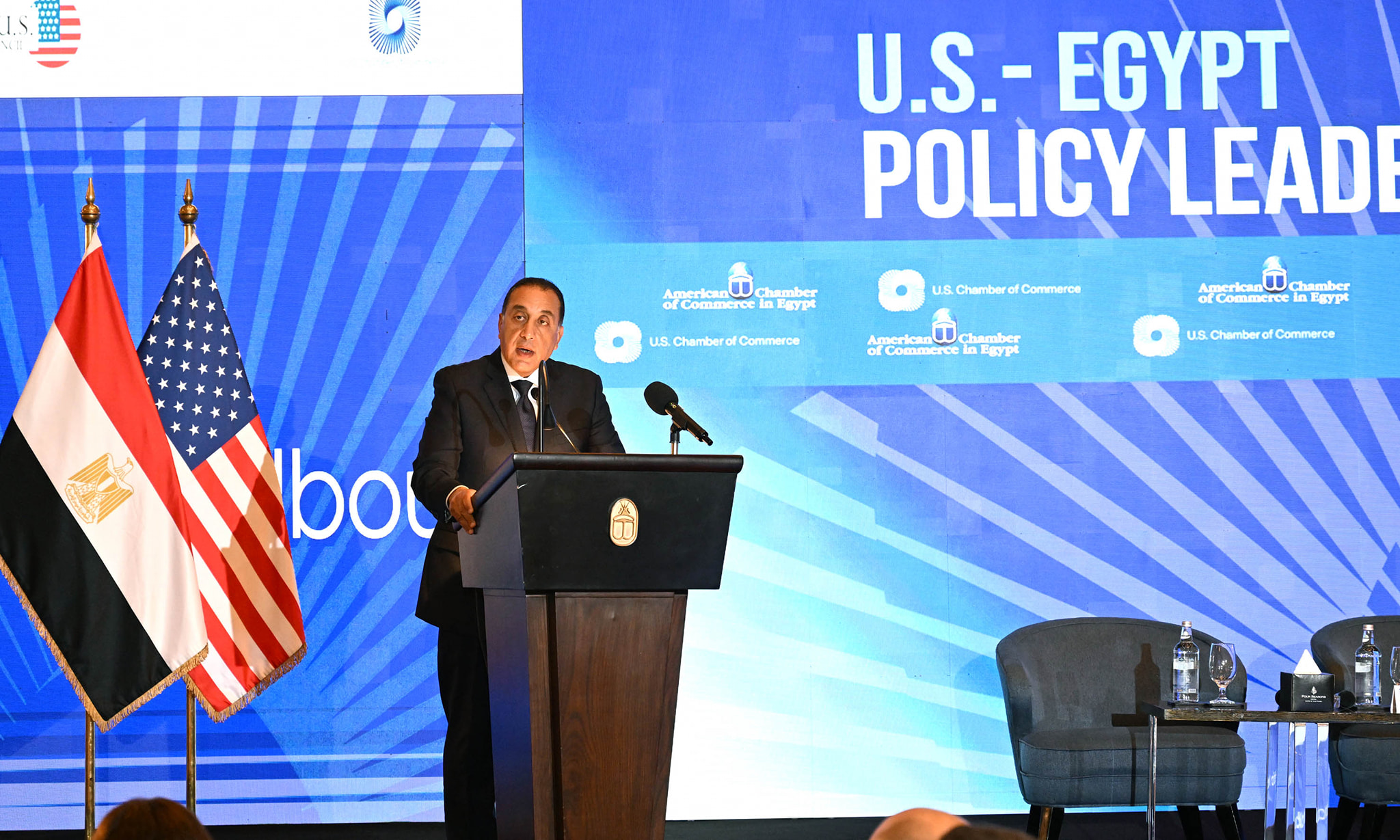
The forum saw attendance from a notable Egyptian ministers, including Lieutenant General Engineer Kamel El Wazir, Deputy Prime Minister for Industrial Development and Minister of Industry and Transport, Dr. Rania Al-Mashat, Minister of Planning, Economic Development, and International Cooperation, Ahmed Kouchouk, Minister of Finance, Engineer Hassan El-Khatib, Minister of Investment and Foreign Trade, and Engineer Karim Badawi, Minister of Petroleum and Mineral Resources. U.S. Ambassador to Cairo, Herro Mustafa Garg, along with representatives from the American Chamber of Commerce and the U.S.-Egypt Business Council, were also present.
Madbouly expressed his appreciation to the American Chamber
of Commerce for organizing the unique event, specifically recognizing Suzanne
Clark, CEO of the U.S. Chamber of Commerce, and John Christmann, CEO of Apache
Corporation and Chairman of the U.S.-Egypt Business Council, for their
leadership. He also welcomed the American business community, noting the
continued success of U.S. companies in Egypt.

Dr. Madbouly underscored the forum's significance in
highlighting the strategic importance of economic cooperation between Egypt and
the United States. This collaboration, built on mutual respect, a shared desire
for prosperity, and a long history of constructive partnerships, has seen both
nations tirelessly enhance various aspects of cooperation over decades, both
bilaterally and regionally, to achieve shared strategic goals.
He emphasized Egypt's consistent role as a reliable and
effective partner to the United States. This partnership, rooted in a shared
understanding that tackling deep-seated challenges in the Middle East requires
deepened cooperation, is particularly crucial today amid rapid regional and
global transformations and unprecedented security and political crises.
Madbouly further articulated that the forum reflects Egypt's
dedication to strengthening the private sector's role in achieving comprehensive
and sustainable economic development. He explained that empowering the private
sector is a cornerstone of Egypt's economic transformation strategy, showcasing
a firm commitment to fostering a competitive, open, and stimulating environment.
This environment enables private institutions to drive innovation, create jobs,
and achieve long-term sustainable growth.
To realize this, the Prime Minister noted that Egypt has
implemented a series of tangible steps. A key initiative is the issuance and
implementation of the "State Ownership Policy Document," which
clearly defines sectors where the state intends to reduce or fully divest its
role, sending a clear message to markets and investors about the state's
evolving role.
Additionally, Dr. Madbouly highlighted the expanded application of Public-Private Partnership (PPP) mechanisms across vital sectors such as transportation, renewable energy, education, and water infrastructure. This expansion has empowered the private sector to take a leading role in developing strategic national assets. Furthermore, dedicated platforms have been established to support investors, notably the "Golden License" system, which grants investors a single Cabinet approval to commence project implementation and operation with minimal administrative procedures.

The Prime Minister detailed Egypt's efforts to cultivate a robust
business climate through comprehensive fiscal and monetary reforms, digitized
government services, and modern regulatory frameworks. These actions have
boosted transparency, predictability, and competitiveness, while reinforcing
the rule of law to attract both local and international investors.
He also highlighted Egypt's multi-billion dollar
infrastructure investments over the past decade. These include expanding
transportation networks, modernizing ports and airports, increasing energy
capacity, and establishing new industrial and logistical zones.
Madbouly further noted the expansion of the Suez Canal, the
creation of the New Administrative Capital, and the development of 24 new
cities. These initiatives establish a foundation for a future economy, aiming
for balanced growth, economic diversification, enhanced production, improved
regional connectivity, and increased foreign investment.
At the heart of Egypt's economic transformation, he
stressed, is the development of its human capital. A skilled, productive, and
innovative workforce, particularly its youth, is crucial for sustainable growth
and fuels the startup and small enterprise sectors. The government is investing
in education, healthcare, and vocational training to prepare the workforce for
future industries.
Finally, the Prime Minister affirmed Egypt's commitment to digitization
and financial inclusion as key drivers of economic growth. Digital technology
is pivotal in reshaping industries and boosting productivity. Egypt's "Digital
Strategy" is propelling the nation toward regional leadership in digital
innovation by integrating advanced technologies like AI, Blockchain, IoT, and
Big Data across all economic sectors.

Prime Minister Moustafa Madbouly highlighted Egypt's unprecedented
transformation under President El-Sisi, which is creating a future with unlimited
opportunities. He noted that over 1,800 American companies operate in Egypt,
with U.S. investments exceeding $47 billion in diverse sectors like energy, IT,
and healthcare. Madbouly urged forum attendees to explore Egypt's abundant
investment opportunities, emphasizing its role as a market of over 107 million
people and a gateway to over 1.5 billion consumers across Africa and the Middle
East through its extensive trade agreements.
The Prime Minister announced two key developments for the
American business community: First, for the automotive sector, effective May
11, Decree No. 112 of 2025 abolished mandatory Egyptian standard specifications
for fully manufactured U.S. vehicles. This regulatory change, notified to the
WTO, opens the Egyptian market to American cars without obstacles.
Second, for dairy products, a permanent exemption from Halal
certification upon import was announced on March 12, 2025, in line with WTO
agreements. The Ministry of Agriculture is also working to increase Halal
certification bodies and potentially reduce assessment fees.
Additionally, Egypt and the U.S. are finalizing a mutual
customs cooperation agreement.
Madbouly concluded by emphasizing that Egypt's economic recovery, structural reforms, and private sector empowerment are all geared towards achieving comprehensive economic development. He delivered a direct message to American businesses: "Our reforms are genuine, our markets are dynamic, and our people are ready. Let's work together to build technologies, industries, and innovations that serve the interests of both our countries." He encouraged attendees to explore investment opportunities throughout the forum.