
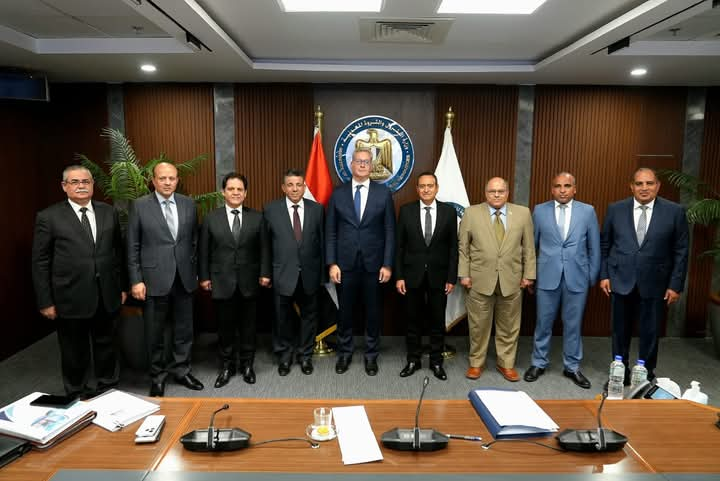
Engineer Karim Badawi stressed the importance of building on Tharwa Petroleum Company's recent achievements in exploration, production, and petroleum services operations, and working to leverage its capabilities and distinguished technical cadres to form a technical arm for the company to explore new investment opportunities, both inside and outside Egypt. This is achieved by forming partnerships with partners willing to invest in these fields, and by leveraging Egypt's digital portal for research and exploration to achieve this goal.
Badawi added that the Ministry continues to support Tharwa Petroleum Company to expand its operations and maximize its competitive capabilities in research and exploration activities both inside and outside Egypt, especially as it is a 100% Egyptian joint-stock company.
Engineer Mahmoud Abdel Hamid, the company's chairman, reviewed the company's most significant business results during the year. He explained that the company succeeded in increasing proven reserves by approximately 3.5 million barrels in the West Kalabsha region in the southern desert, opening new horizons for development operations to increase production rates. He noted that the company is pursuing a policy of rationalizing expenditures, particularly direct operating expenses in the areas under its management. This is achieved by beginning to replace leased production facilities with permanent ones, in addition to improving energy efficiency and narrowing the gap between generated electrical capacity and used loads. He also highlighted the optimal utilization of associated gases and their use as an alternative fuel to diesel, which has contributed to achieving tangible savings in diesel consumption, in addition to the positive environmental impact of reducing carbon dioxide emissions.
He added that the company succeeded in 2024 in achieving 3.7 million safe working hours without lost time, for the ninth consecutive year, as a result of its continuous efforts to promote a culture of occupational safety and health among employees. This was achieved through the implementation of numerous training courses to qualify and train employees, in addition to awareness seminars within the framework of sustainable development.
The company also paid great attention to implementing the necessary training programs to develop human resource skills, as this is the fundamental pillar of a model for establishing the principle of continuous development and achieving sustainability, in line with the Ministry's strategy towards digital transformation. A human resources management system was developed using the SAP system.