
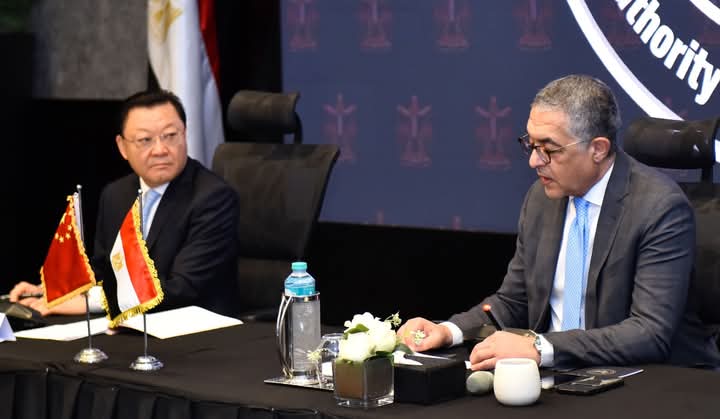
The meeting agenda focused on investment cooperation for the second half of 2025. Key initiatives include the Ministry of Investment and Foreign Trade's participation in the World Economic Forum in Tianjin, China (June 24-26), followed by meetings with the Chinese business community in Beijing and Shanghai. Plans are also underway for the Egyptian-Chinese Investment Forum in Cairo next July, expected to be attended by Chinese Vice Minister of Commerce Wang Shouwen, and for participation in the China Import and Export Fair in Guangdong Province next October, which anticipates 60,000 economic institutions, among other events.
Hossam Heiba attributed the robust investment cooperation
agenda between the two nations to several key drivers: the strong political
ties between their leaderships, Egypt's appealing investment climate, and
ongoing shifts in the global economy. These factors have spurred a worldwide
reevaluation of investment strategies and the necessity for new value chains.
Consequently, GAFI is witnessing a growing influx of Chinese investment
delegations seeking opportunities in Egypt.
GAFI data indicates a significant Chinese business presence
in Egypt, with approximately 2,800 companies representing over $8 billion in
total investment. This includes prominent brands familiar to the Egyptian
market, such as OPPO, Haier, Jushi, Midea, TEDA, Huawei, and Brilliance. The
CEO of GAFI emphasized the Egyptian government's strong focus on attracting
Chinese investment, citing the goals of technology transfer, substantial job
creation, and the typically large scale of these investments. A key initiative
in this regard is GAFI's plan to establish a comprehensive Chinese textile city
in Minya Governorate, in partnership with the China National Textile and
Apparel Council, operating under the export-supporting free zones system.
Furthermore, three major Chinese companies—Haier, Midea, and Shen Feng—have
been granted the Golden License, streamlining their establishment and operation
with comprehensive permits.
Hossam Heiba stated that the Egyptian government is actively
seeking Chinese investments in key sectors such as automobile manufacturing,
building materials, textiles, electronics, renewable energy, data centers, and
artificial intelligence.
Wang Weizhong affirmed the strong diplomatic and economic
ties with Egypt, a comprehensive strategic partner since 2014 (China's highest
level of foreign relations), citing President Xi Jinping's directives for
stronger cooperation. He noted Guangdong Province handles one-fifth of China's
trade with Egypt and its residents are top consumers of Egyptian tourism,
proposing a permanent Egyptian cultural exhibition in the province to boost
tourism.
GAC Group Chairman Feng Xingya announced a $300 million
investment to establish a car factory in Egypt, aiming to serve the local
market and export, citing the Egyptian government's support for the automotive
industry under Dr. Moustafa Madbouly.
ZTE CEO Chu Peng stated the company aims to expand in the
Egyptian market and localize Chinese technology, capitalizing on high demand
from Egyptian telecommunications service providers to develop sector
infrastructure.
OPPO Egypt General Manager Ma Jixiong stated that since investing in Egypt in 2014, the company has established two factories spanning over 20,000 sqm, creating 1,000 jobs and producing 4-5 million phones annually. He announced the parent company's plan to make its Egyptian operations its second major manufacturing hub after China, serving local and regional markets.