
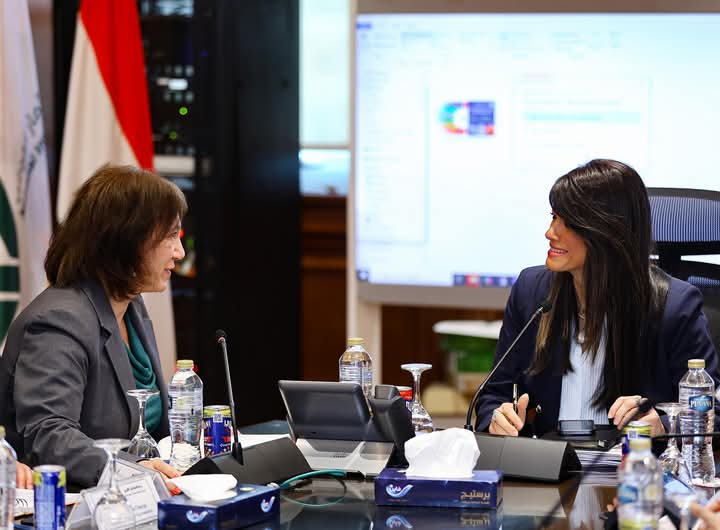
The meeting involved extensive discussions on Egyptian economic developments across various levels. Participants explored measures to boost economic growth, focusing on tradable and export-oriented sectors. They also addressed state actions to encourage private sector involvement in development and the governance of public investments to ensure macroeconomic stability and create opportunities for the private sector.
The Minister noted that the Egyptian economy has regained growth
momentum since the March 2024 economic reforms. Despite prior significant
challenges, growth has increased, reaching 2.4% in the last quarter of the
previous fiscal year, followed by 3.5% and 4.3% in the first and second
quarters of the current fiscal year.
Al-Mashat highlighted that indicators show significant
improvement in both level and quality of growth. The non-petroleum
manufacturing sector led growth, along with telecommunications and IT, tourism,
and transportation/storage, despite the negative impact of geopolitical
tensions causing a significant decline in Suez Canal activity.
The Minister discussed the government's strategic economic
shift towards tradable, exportable, and value-added sectors, alongside
structural reforms to adjust fiscal policies, reduce public debt, and attract
foreign direct investment.
She also highlighted cooperation with international partners
to secure budget support for comprehensive economic reforms, particularly the
EU's macroeconomic and deficit support mechanism. This involves a package of
measures to boost macroeconomic stability, improve the business climate, and
promote a green economy, aiming to finalize the second phase of approximately 4
billion euros in budget support.
Al-Mashat emphasized that international partnerships extend
beyond budget support, with $14.5 billion in concessional financing directed to
Egypt's private sector in five years. She highlighted the NWFE program's energy
pillar, which secured $3.9 billion for 4.2 GW of renewable energy projects in
two years, aiming for $10 billion and 10 GW to reach Egypt's 42% renewable
energy target by 2030.
The Minister also highlighted debt-for-development swap programs with international partners as a mechanism to reduce debt while fostering growth, employment, and sustainable development. Egypt has significant programs with Italy and Germany and a prior agreement with China in this area.