
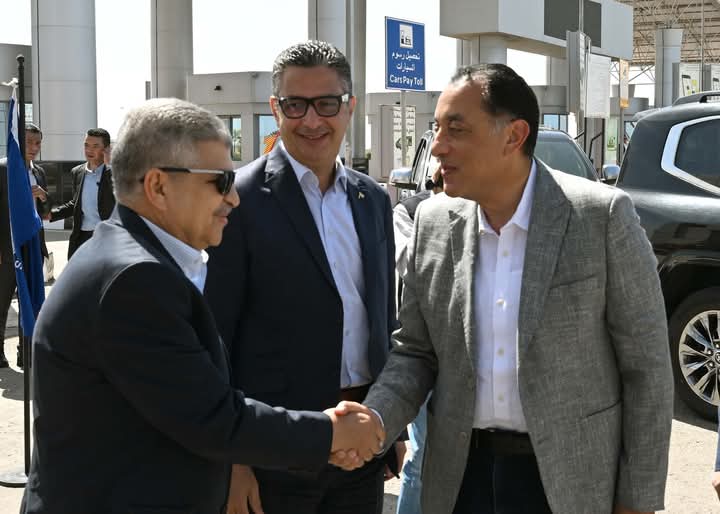
Madbouly toured the port's old container exchange quay to monitor traffic and assess the volume of activity. He also listened to a presentation on the ongoing development work and followed the progress of the work from a viewing point. Engineer Ashraf Abdel Shafi, Director of Projects and Development at the SCCT, pointed out that the SCCT is an Egyptian joint-stock company operating under the private free zone system and has been a container terminal at East Port Said Port since 2004. It is an arm of the global A.P. Moller-Maersk Group, one of the world's largest container port operators and owner of some of the world's largest container ships.
He pointed out that the SCCT is unique in its unique location at the northern entrance to the Suez Canal, with an area of about 1.2 million square meters and a quay length of 2,400 meters, with investments amounting to $1 billion.
Abdel Shafi also indicated that the Suez Canal Company's contribution amounts to approximately 55% of the total volume of transit containers handled in Egyptian ports, approximately 35% of Egypt's refrigerated container exports, and approximately 12% of Egypt's exports and imports.
He added that the port's draft is 18.5 meters, the largest in any port, allowing it to receive the latest generation of giant container ships. The terminal has received more than 30,000 ships since it began operating in 2004, handling more than 50 million containers. He also added that the terminal employs approximately 3,200 direct and indirect workers, and an additional 1,000 job opportunities will be created through the extension project of the current terminal. It is worth noting that the terminal's ranking has risen to tenth place globally according to the World Bank's 2022 rankings in terms of operational efficiency, safety rates, and handling volume.
Abdel Shafi stressed that the terminal is pursuing a clear policy to reduce carbon emissions, in line with international efforts in this regard and in line with the vision and direction of the global A.P. Moller-Maersk Group. On August 15, 2023, the terminal's quay welcomed the world's first container ship powered by green methanol, on its maiden voyage to Europe from Singapore. The green methanol fueling process was the first of its kind in Egypt and the Middle East, reflecting the group's confidence in the terminal's operational efficiency and its great faith in the capabilities of the Egyptian state. It is worth noting that all equipment in the terminal's extension project currently under construction is electrically powered to reduce carbon emissions, positioning the terminal among the world's greenest container terminals.
Engineer Karim Tayeb, the supervisor of the new extension project for the SCCT, confirmed that, as a result of the Egyptian state's vision to provide investment incentives and attract more foreign investment, the company signed a concession agreement between the SCCT and the Egyptian state. This agreement culminated in the President signing Law No. 165 of 2023, granting the commitment to finance, design, construct, manage, operate, and maintain the second terminal for the SCCT. The agreement also includes an additional 955 meters, bringing the quay length to approximately 3,400 meters, with additional investments amounting to $500 million. This will make the terminal the largest in the Eastern Mediterranean region, with a capacity of 7 million containers. Infrastructure work for this massive national project has already begun, and the first phase of the project was completed on April 1, 2024. Approximately 24 ships have already been received at the new terminal's quay.
Tayeb noted that the terminal is capable of handling all types and sizes of container ships, particularly the latest generations, with a capacity of 18 state-of-the-art quay cranes and 60 yard cranes. This is in addition to receiving and installing 12 giant cranes and 30 yard cranes, bringing the total number of cranes to 30 quay cranes and 90 yard cranes. He added that the terminal's handling capacity is 5 million containers, which will eventually increase to 7 million containers. He noted that despite the challenges facing shipping traffic in the Red Sea, the company has succeeded in achieving the highest container handling rate in its history, handling 4 million TEUs in 2024.