
The two sides intend to utilize technological tools such as artificial intelligence, smart systems, and big data processors to improve the efficiency and sustainability of utility distribution networks, including electricity, water, and sanitation. Additionally, they aim to provide technical solutions to enhance the efficiency of fire protection services, electric vehicle charging, street and home lighting, and other essential services for smart city residents.
According to the agreement, the production of technological
solutions will be distributed between Egypt and Spain. Furthermore, students
from El Sewedy School for Applied Technology will be integrated into all stages
of cooperation between the two sides to prepare them for work in the company's
factories in both Egypt and Spain.
The agreement was signed by Engineer Emad Elsewedy, Chairman
of Elsewedy Electrometer Group, and Dr. Andrés Llombart Estopiñán, CEO of the
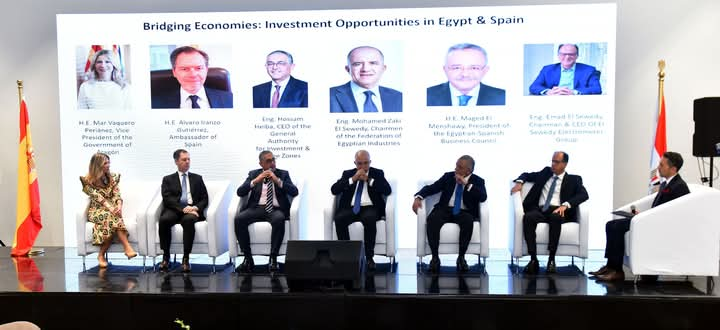
CERSEI Foundation. The signing was witnessed by María del Mar Vaquero Periáñez,
Vice President of the Government of Aragon, Spain, Ambassador Álvaro Iranzo
Gutiérrez, the Spanish Ambassador to Egypt, Engineer Mohamed Zaki El Sewedy,
Chairman of the Federation of Egyptian Industries, and Engineer Maged El
Menshawy, Chairman of the Egyptian-Spanish Business Council.
Engineer Emad Elsewedy said this agreement fits Elsewedy
Electrometer Group's goal: "investing in technology to prepare for
industry investment." He noted that recent global events show technology
producers can lead the global market and grow sustainably. He also highlighted
that this agreement is a key step for cooperation between both countries, not
just the two organizations. It will offer tech solutions for all companies and
consumers in both nations, shielding them from negative trade impacts.
María del Mar Vaquero Periáñez stated that this agreement
will positively impact both countries. She emphasized the Aragon region's
strong focus on technology, engineering, and environmental sustainability. She
noted that the automotive industry accounts for 30% of Aragon's industrial
output, and the region contributes significantly to Spain's energy sector,
providing about 80% of its renewable energy capacity and 12% of its total energy
supply. She also mentioned that Zaragoza, the capital of Aragon, hosts
"The Wave" conference, a major European entrepreneurship event. She affirmed
her country's desire to cooperate with the Egyptian technology sector, which is
rich in young talent and accumulated experience.
Hossam Heiba reviewed Egypt's latest investment regulations
and incentives, highlighting that its free zone system is ideal for facilities
using the advanced technology from this agreement. Egypt currently has nine public
and four upcoming public free zones, plus 230 private ones, all with full tax and
customs exemptions. This eases re-export to Europe, the Middle East, and
Africa, with 20% allowed for the Egyptian market.
Heiba also noted Egypt's move to integrate with African
competitors like Morocco and South Africa to boost investment and intra-African
trade. Egypt has signed MOUs and cooperation deals with nearly all African
investment promotion bodies, simplifying the creation of joint manufacturing
and tech centers across the continent.
Engineer Mohamed Elsewedy emphasized significant
opportunities for cooperation between Egypt and Spain to speed up their
commitment to European environmental sustainability standards.
Ambassador Álvaro Iranzo Gutiérrez, the Spanish Ambassador
to Egypt, stated that the two countries share many commonalities that can
support development across the Mediterranean region.
Engineer Maged El Menshawy, Chairman of the Egyptian-Spanish Business Council, highlighted numerous successful investment collaborations between the two countries since the early 2000s in sectors like petroleum, water and wastewater treatment, pharmaceuticals, transportation, and railways. He suggested directing some of the technical cooperation between El Sewedy Electrometer and CERSEI towards the tourism sector, given that both nations are major global tourist destinations with unique attractions that modern technology can enhance.