
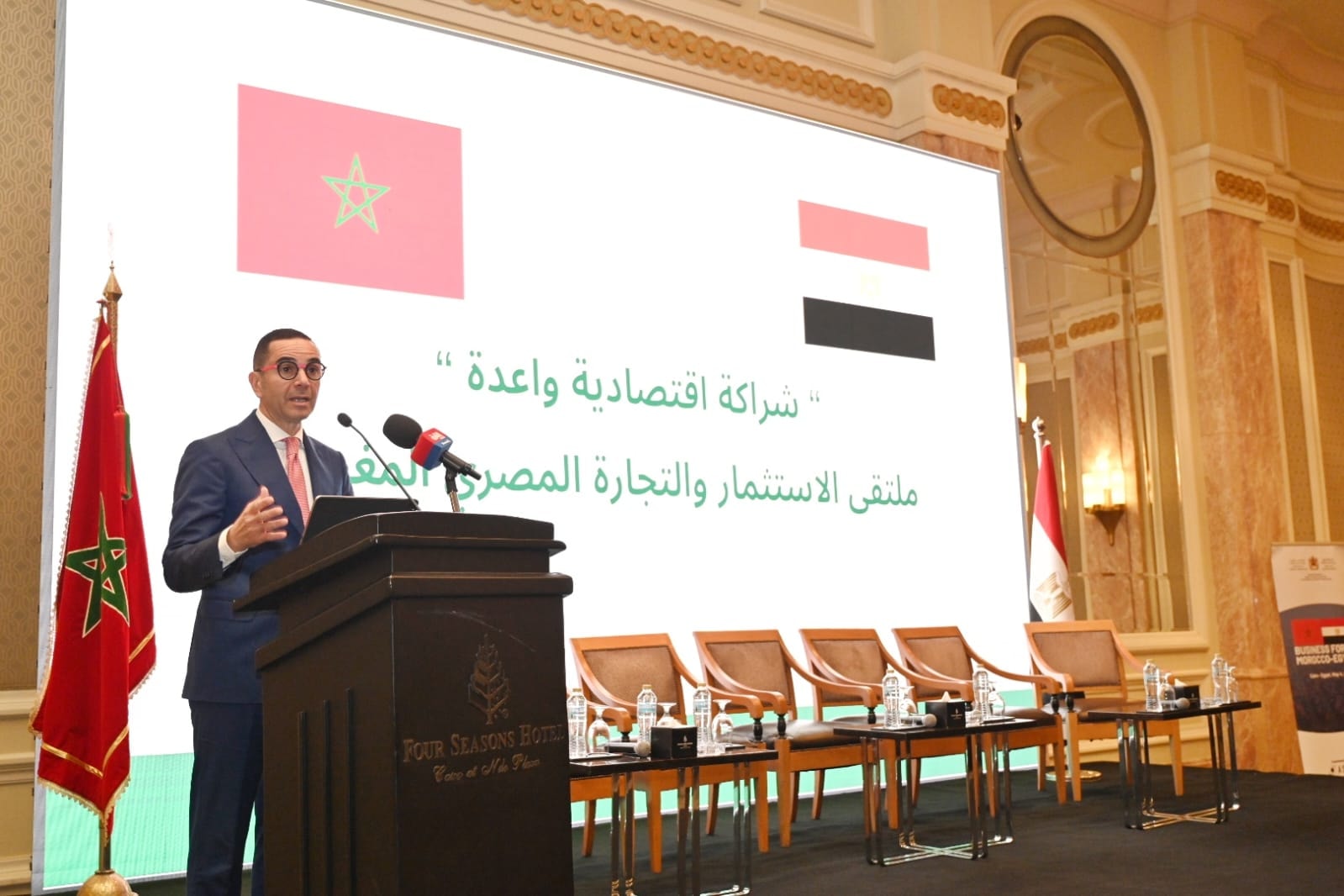
The Minister thanked the Moroccan Foreign Trade Minister and the accompanying delegation for accepting the invitation to Egypt, a visit intended to strengthen bilateral relations. He expressed hope that this engagement would foster greater cooperation across various sectors and unlock new bilateral and regional opportunities for mutual benefit.
Al-Khatib emphasized that the forum seeks to establish
ongoing, productive communication between the two nations. He highlighted the
significance of such meetings as a key tool for assessing and enhancing trade,
particularly Morocco's exports to Egypt, noting that current figures understate
Morocco's potential within the Egyptian market's existing opportunities.
The Minister stated that preferential trade agreements,
including the Greater Arab Free Trade Area, the Agadir Agreement, and the
African Continental Free Trade Area (AFCFTA), stimulate economic growth and
broaden access to foreign markets. He affirmed that these joint agreements
demonstrate both countries' dedication to advancing economic relations and
expressed optimism that they would ease trade and create new markets for
domestic products. This can be achieved by leveraging the cumulation of origin
through commercial and investment partnerships and establishing joint ventures
in diverse economic sectors.
Al-Khatib urged business leaders from both nations to
exchange ideas and propose collaborative projects to deepen economic ties for
mutual benefit. He underscored the strong historical bonds between Egypt and
Morocco, rooted in deep understanding and the high regard held by the political
leadership and the Egyptian people for their Moroccan counterparts. He noted
that this necessitates both governments to advance economic and trade relations
and conveyed his best wishes for the continued success, progress, prosperity,
and growth of the Moroccan political leadership and people.
The Minister emphasized the Egyptian government's active
efforts to eliminate trade and investment barriers. These include streamlining
customs procedures to reduce the time and cost of releasing goods, with the
goal of enhancing economic performance, modernizing production, and creating a
welcoming environment for international trade and investment. He expressed his
hope that these significant efforts would positively encourage Moroccan
companies.
The Minister emphasized the need to address all obstacles
facing exporters and importers in both countries and to leverage existing
agreements. He highlighted the importance of joint efforts to overcome
challenges posed by geopolitical shifts and health crises like the Coronavirus,
which negatively impacted the economy. This necessitates stronger industrial,
commercial, and investment cooperation to enhance the economic partnership
between Egypt and Morocco, ultimately fulfilling the aspirations of both
nations and achieving sustainable development in areas of mutual interest.
Al-Khatib encouraged business leaders from both countries to
coordinate, envisioning this meeting as the start of a new era of joint
cooperation. He emphasized the government's commitment to resolving any
obstacles hindering the flow of Moroccan exports to Egypt.
Moroccan Foreign Trade Minister Omar Hejira affirmed the
deep historical ties between Morocco and Egypt, underpinned by a robust legal
framework including the Free Trade Agreement and the Greater Arab Free Trade Area
Agreement. He noted that this framework provides a foundation for a promising
regional partnership encompassing the Arab world and Africa.
Minister Hejira emphasized a strong political commitment to
increasing Moroccan exports to Egypt through concrete actions already underway.
These include simplifying the registration and accreditation of Moroccan
products and establishing a fast track for Moroccan goods within the Egyptian
market.
Hejira explained that the Moroccan delegation's visit to
Cairo clearly signals Morocco's serious intent to forge integrated economic
partnerships with Egypt. He stressed that such integration is the optimal
approach to confronting global trade challenges, building a competitive
regional economy, achieving development, and generating employment
opportunities.
Ahmed El-Wakeel, Chairman of the Federation of Egyptian
Chambers of Commerce, stated that the forum presents a significant opportunity
to create jobs for young people by fostering joint manufacturing and pursuing
tripartite cooperation with neighboring nations. He also mentioned the goal of
establishing new shipping routes between the two countries.
El-Wakeel highlighted the strategic importance of leveraging
Egypt and Morocco as logistical hubs for accessing markets in Africa, Europe,
and Asia, capitalizing on free trade agreements and support programs offered by
the European Union. He advocated for increased product exchange and a rise in
Egyptian exports to the Moroccan market.
Concluding the forum, participants emphasized the necessity of activating political will and translating it into concrete investment projects. These projects should contribute to building a shared economic future that benefits the people of both nations.