
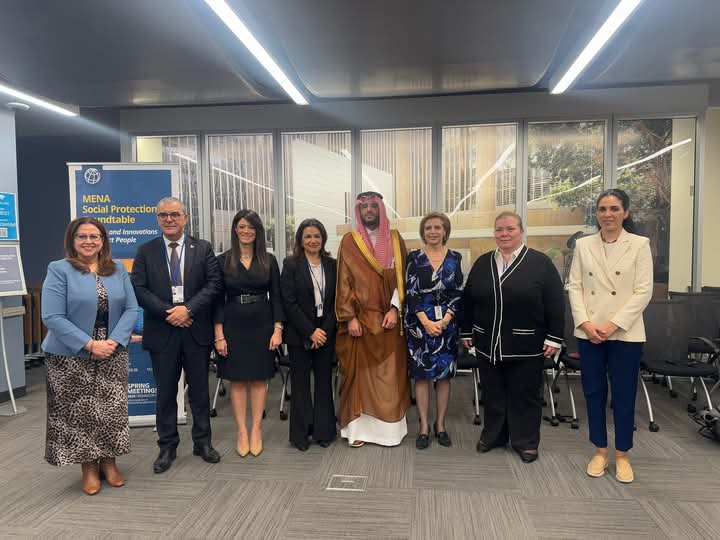
This came at a special event on social protection during the Spring Meetings of the World Bank Group (WBG) and the International Monetary Fund (IMF) held in Washington, under the title "Social Protection in the Middle East and North Africa: Lessons and Innovations to Protect Individuals." This event highlighted the close partnership between Egypt and the WBG and the Bank's active role in financing numerous vital projects in various sectors, including social protection and infrastructure. The "Takaful and Karama" program began implementation in 2015, and the WB has financed it with approximately $1.4 billion over 10 years.
Dr. Al-Mashat reviewed the Egyptian state's efforts in
the field of social protection and the pioneering experience of implementing
the "Takaful and Karama" program since 2015 to protect the
lowest-income groups and promote financial inclusion and social integration.
She added that in light of the increasing economic
challenges at the regional and international levels, and the successive
negative impacts on the Egyptian economy, the urgent need has emerged to develop
social safety networks capable of protecting the lowest-income groups in
society, especially in times of crisis.
Al-Mashat stressed the Egyptian government's belief
that providing social protection is not only a humanitarian necessity, but also
a cornerstone in maintaining social cohesion and economic stability. She also
developed the legislative framework for the system through the Social Security
and Cash Support Fund Law, which represents a milestone in the history of
social protection in the country.
She noted that the law transforms the “Takaful and
Karama” program from a mere national initiative into a legal right guaranteed
to all eligible citizens, especially the most vulnerable groups such as the
elderly, orphans, people of determination, and the unemployed. The law
stipulates that the state is committed to providing fair and comprehensive
social protection that guarantees citizens' dignity and equal opportunities, in
line with Article 8 of the Egyptian Constitution, which affirms that "society
is based on social solidarity, and the state is committed to achieving social
justice and providing means of social solidarity to ensure a decent life for
citizens."
The Minister highlighted the strategic partnership with
the WB in designing, implementing, and developing the "Takaful and
Karama" program. Over the course of ten years, the Bank has provided
development financing worth $1.4 billion, along with technical support from
Bank experts who have contributed to building the capacity of government employees
involved in implementing the program, digitizing cash support disbursements
through the introduction of "Meeza" cards, developing monitoring and
evaluation mechanisms, and promoting the concept of "human
development" as a priority within the program. This technical and
financial support has enabled the Egyptian state to reach more than 4.6 million
beneficiary families across the country, reflecting the program's significant
societal impact.
She said that the WB is positioning the "Takaful
and Karama" program, which is coordinated in cooperation with the Ministry
of Social Solidarity, as a model for national social protection programs and is
seeking to implement it in other countries.
Al-Mashat stated that the program is divided into two
main tracks: the Takaful track for groups capable of working but temporarily
unemployed, and the Karama track for groups unable to work, such as people of
determination, the elderly, and orphans. She noted that to ensure investment in
children's futures, the program requires families benefiting from Takaful to
commit to enrolling children in school and achieving an attendance rate of no
less than 80%. It also requires women and children to undergo periodic health
checkups three times a year. These conditions aim to break the cycle of
intergenerational poverty by providing children with education and healthcare,
and empowering women to support their families physically and economically.
She stressed that women's empowerment is a key focus of
the program, as women constitute 75% of support card holders. The program has
helped enhance women's ability to make economic decisions within their families
and improve their social standing, which positively impacts the standard of
living of all families. She explained that the state is moving toward making
economic empowerment the ultimate goal of social protection. Work is currently
underway to place "Takaful" beneficiaries who are able to work on a
specific timetable that qualifies them to "graduate" from the program
and transition to self-reliance through job opportunities or small businesses.
The “Takaful and Karama” Program has benefited 4.67
million registered families and approximately 17 million direct and indirect
beneficiaries. 51% of families covered by the Takaful Program comply with
health requirements, including three visits to a health unit annually. 63% of
families covered by the program comply with education requirements, including
an 80% school attendance rate. 100% of beneficiaries receive cash payments
electronically.
In October 2023, the House of Representatives announced its approval, in its plenary session, of Presidential Decree No. 220 of 2023 approving the agreement between the Arab Republic of Egypt and the WB to expand the Takaful and Karama cash transfer and systems building program, with funding amounting to $500 million. This reinforces the state's commitment to increasing efforts to protect the lowest-income groups through various programs.