
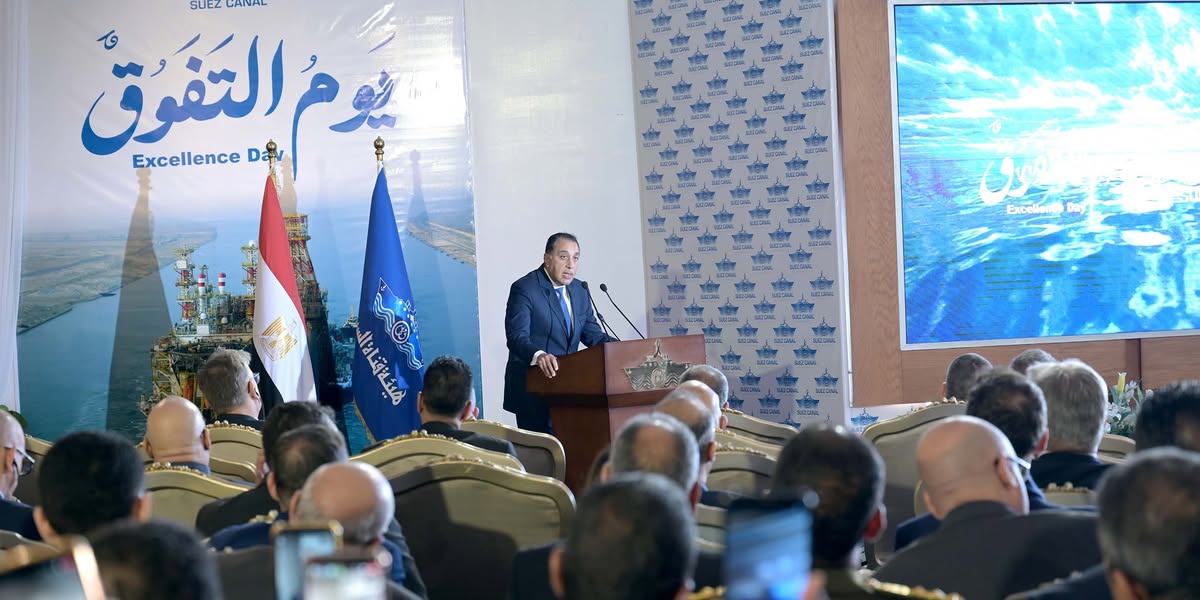
Madbouly delivered a speech in which he welcomed the attendees to that blessed spot on the banks of the New Suez Canal, where the waters of the Red Sea and the Mediterranean Sea met for the first time in ten years in August 2015. This new vital artery connects East and West, ensuring sustainability for global supply chains, and heralding a new and advanced approach to managing one of the most important shipping lanes in the world, if not the most important.
He added that since this date, the SCA has witnessed continuous,
uninterrupted efforts, achieving a breakthrough in the Canal's navigational
development projects by deepening the waiting areas at the northern and
southern entrances to the Canal, constructing emergency garages, and giant
mooring bollards for tying up ships. This was followed by the largest project
to develop the southern sector of the Canal, which had not seen any development
since 1990 due to the difficulties and challenges associated with the extremely
hard, rocky soil in that area.
Madbouly pointed out that despite the various challenges the Suez
Canal has faced and continues to face, the continued support of President Abdel
Fattah El-Sisi, along with the availability of human and technical capabilities
within the venerable authority, has been the primary driver of the authority's
success in overcoming difficult situations and successive crises.
He continued, "Today, we are experiencing an unprecedented
security crisis in the Red Sea region, which has had a profound impact on the
decline in navigation rates through the canal and the decline in revenues
generated. This is despite the fact that the causes of the crisis are not
primarily related to the Suez Canal. This constitutes a burden on the interests
of the Egyptian state, given that the canal is one of the most important
sources of foreign currency."
The Prime Minister clarified that the Egyptian state, from the first
day of the crisis, demonstrated an understanding of the political and economic
repercussions and did not engage in any measures that conflicted with its
regional role. On the contrary, it worked to take effective steps to
politically resolve the roots and causes of the crisis and offset the resulting
negative economic impacts by taking concrete steps to promote investment,
localize heavy industries, keep pace with the global trend toward clean and
renewable energy, develop tourism attractions, and other activities included in
the Egyptian state plan, at the heart of which is the Suez Canal and the SCZone.
Madbouly continued, saying: "From that perspective, we are
today witnessing a radical transformation in the activities and services of the
Suez Canal, the scope of its partnerships, and its openness to the world. It
has transformed from a maritime authority primarily concerned with managing the
Suez Canal's maritime facilities into an authority with diverse maritime and
logistical activities and services." The Prime Minister added that the SCA
has begun developing and expanding new services, such as ship maintenance and
repair services at the Authority's shipyards, marine ambulance and crew
replacement services, and a safe and sustainable waste collection and removal
service for ships transiting the Canal, in line with the Authority's efforts to
achieve a green transformation by 2030.
He said: "I witnessed the signing of the joint cooperation
agreement between the SCA and the Greek company Antipollution to provide a safe
waste collection service for ships transiting the Canal. Today, we are
witnessing the fruits of these efforts with the availability, announcement, and
provision of this service by Egyptian hands using advanced, environmentally
friendly technologies."
Dr. Madbouly continued, saying, "This partnership embodies a
success that demonstrates the Egyptian state's efforts to expand its efforts to
attract foreign investment and establish partnerships with major international
companies. It is a serious call that we hope, through the ambassadors of the
European Union countries and our partners in success from the entities
concerned with the maritime transport, maritime services, and logistics
industries, will invest in, so that the Suez Canal and the SCZone become a
global platform for maritime and logistics services."
He clarified that the Suez Canal is working in parallel to strengthen national partnerships to localize the marine unit and tourist yacht construction industry through the Egyptian Locomotive Factory and the Suez Canal Modern Boats Company within the Safaga Free Zone, in partnership with the South Red Sea Shipyard Company. He added that these are ongoing efforts at various levels to break through the bottleneck and open up broader horizons of development, modernization, and growth for the Suez Canal and its surrounding economic zone, which constitutes the true guarantee for the Canal's leadership and enhances its role and global standing, no matter how severe the surrounding challenges become.