
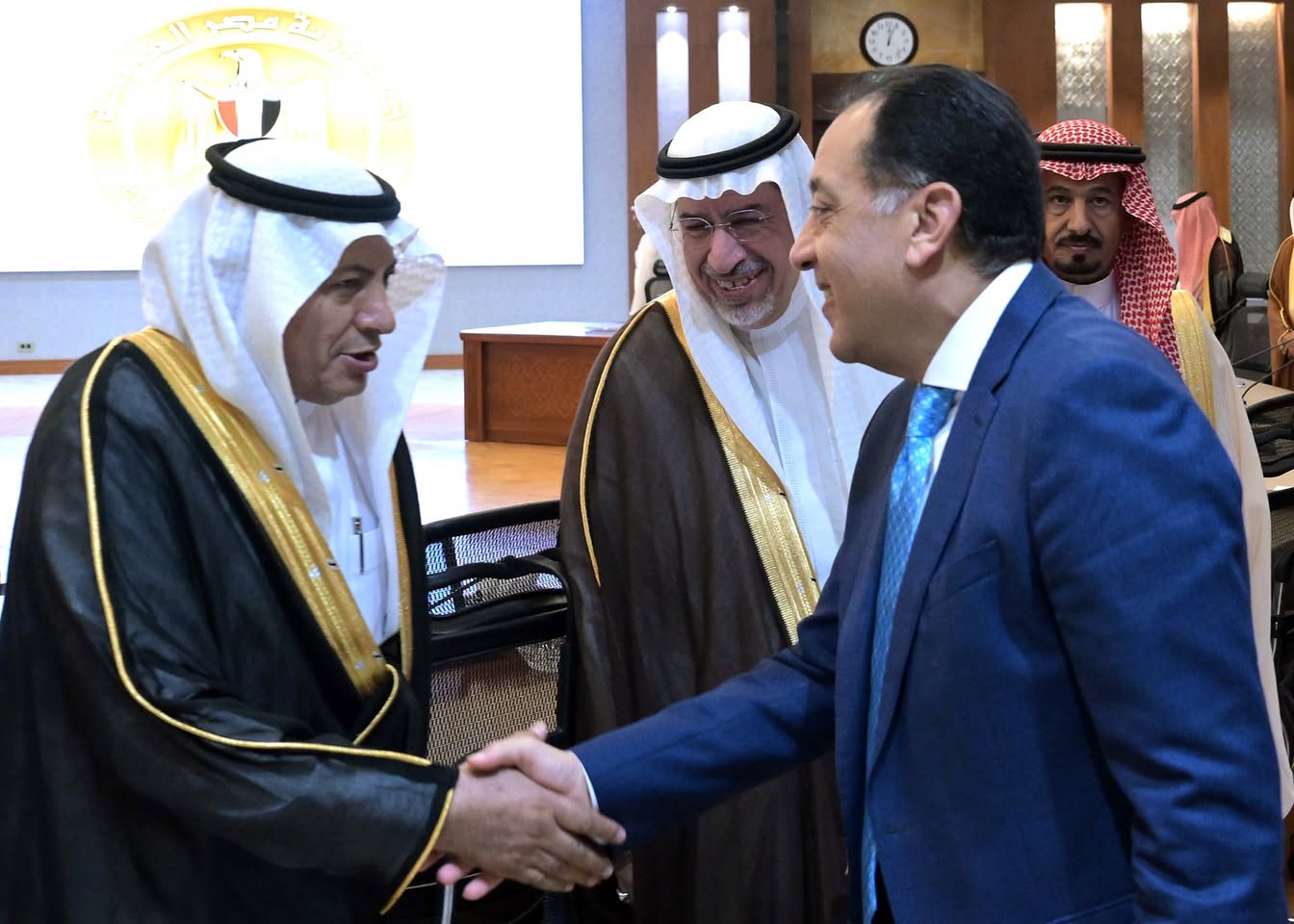
This meeting followed the Egyptian-Saudi Business Forum held in Cairo yesterday, which was attended by Engineer Ibrahim Al-Mubarak, CEO of the Saudi Authority for Investment Marketing, Saleh bin Eid Al-Husseini, the Saudi Arabian Ambassador to Cairo, Hassan Moajeb Al-Huwaizi, Chairman of the Federation of Saudi Chambers, Hossam Heiba, CEO of the General Authority for Investment and Free Zones, Ambassador Ehab Fahmy, Assistant Minister of Foreign Affairs for Arab Affairs, as well as members of the Federation of Saudi Chambers and heads of several prominent Saudi companies.
Dr. Madbouly invited the Saudi businessmen to tour the New
Administrative Capital to witness the significant advancements in urban
development in the region.
Madbouly underscored the mutual desire of the two nations to
deepen economic ties and the Egyptian government's dedication to bolstering
investment partnerships with Kingdom of Saudi Arabia. He highlighted the
Egyptian market's strong emphasis on providing unprecedented support to the
foreign private sector and encouraging increased investments from Arab and
foreign companies.
In this regard, the Prime Minister noted the entry into
force of the Agreement on the Promotion and Protection of Mutual Investments
between Egypt and Saudi Arabia. He emphasized that this agreement marks a new
phase for enhanced economic cooperation between the two nations and serves as a
catalyst for increased trade, particularly within the private sectors.
He affirmed the Egyptian government's ongoing efforts to
create an attractive investment environment, remove hurdles for investors, and
provide comprehensive support and facilities. He stated, "We have
implemented numerous measures to improve the business climate, develop
infrastructure, and streamline government procedures, including tax and customs
systems, alongside offering incentives to investors across various sectors.
Madbbouly stressed the significance of Egyptian-Saudi
cooperation and integration in establishing joint projects of strategic and
economic importance. This aims to leverage the comparative advantages of both
countries to address global challenges, achieve economic integration, and
strengthen food security. He concluded by stating that Egypt offers promising
investment opportunities and that building strong ties and partnerships is the
optimal path forward for both nations.
He reaffirmed the government's strong commitment to
resolving challenges facing Saudi investors in Egypt, in close collaboration
with relevant bodies. He pointed to the establishment of a Cabinet committee,
chaired by First Assistant Prime Minister Engineer Randa Al-Menshawy, tasked
with addressing these issues. This committee meets regularly with stakeholders
to pinpoint problems and develop appropriate solutions, in line with investment
promotion and protection principles. The Saudi Embassy in Cairo is kept
regularly informed of progress.
Dr. Madbouly emphasized the committee's significant efforts
to resolve Saudi investor problems, stating, "We have successfully
resolved most of these issues, including some that persisted for decades, and
are actively working on the remaining ones." He reiterated his ongoing
dedication to resolving Saudi investor concerns. He expressed his keen interest
in attracting more Saudi investment to Egypt, emphasizing the country's
attractive investment potential.
In this context, he detailed prominent investment
opportunities in the industrial sector, encompassing the production of solar
energy components, storage batteries, rubber, car batteries, desalination plant
components, aluminium, electrical transformers, seamless pipes, large water
pumps, household appliance motors, polyester, soda ash, control panels,
automotive glass, electric vehicles, and ready-made clothing. He highlighted
the advantage of leveraging Egypt's trade agreements with regional and
international blocs.
Madbouly further presented opportunities in the
communications and information technology sector, emphasizing the significant
comparative advantage offered by Egypt's young, skilled, and capable workforce
in this area.
The Prime Minister reviewed tourism investment opportunities
in Egypt, pointing to those on the northwestern and eastern coasts, as well as
other tourist destinations nationwide. He also outlined several investment
opportunities in the agricultural sector.
Engineer Ibrahim Al-Mubarak, CEO of the Saudi Authority for Investment Marketing, appreciated the Prime Minister and relevant ministers for their swift action in implementing the agreement on the encouragement and protection of mutual investments, stating, "Our visit to Egypt confirms Saudi companies' interest in operating here."
The CEO noted that their participation in the Egyptian-Saudi
Business Forum involved crucial consultations with both Egyptian governmental
and private sectors. They learned about Egypt's diverse investment
opportunities and observed the keen interest of Egyptian businessmen in
investing in the Kingdom.
He expressed his hope for stronger economic ties between the
two nations, considering their economies as cornerstones of regional stability.
He also highlighted significant potential for joint tourism programs offering
varied options for tourists, underscoring the possibility of substantial
bilateral integration in this area. Furthermore, the CEO stressed the necessity
of industrial integration between the two countries, given current global
commercial developments.
Hassan Moajeb Al-Huwaizi, Chairman of the Federation of Saudi Chambers, thanked President Abdel Fattah El-Sisi and the Prime Minister for their strong support of the Saudi private sector. He commended the efforts of the Cabinet committee, chaired by First Assistant Prime Minister Engineer Randa El-Menshawy, in addressing Saudi investors' issues. He affirmed Saudi businessmen's conviction that Egypt is an attractive and enabling investment market, and praised the significant progress in the New Administrative Capital, remarking, "The development and construction in the New Administrative Capital is a source of pride for all Arabs.”