
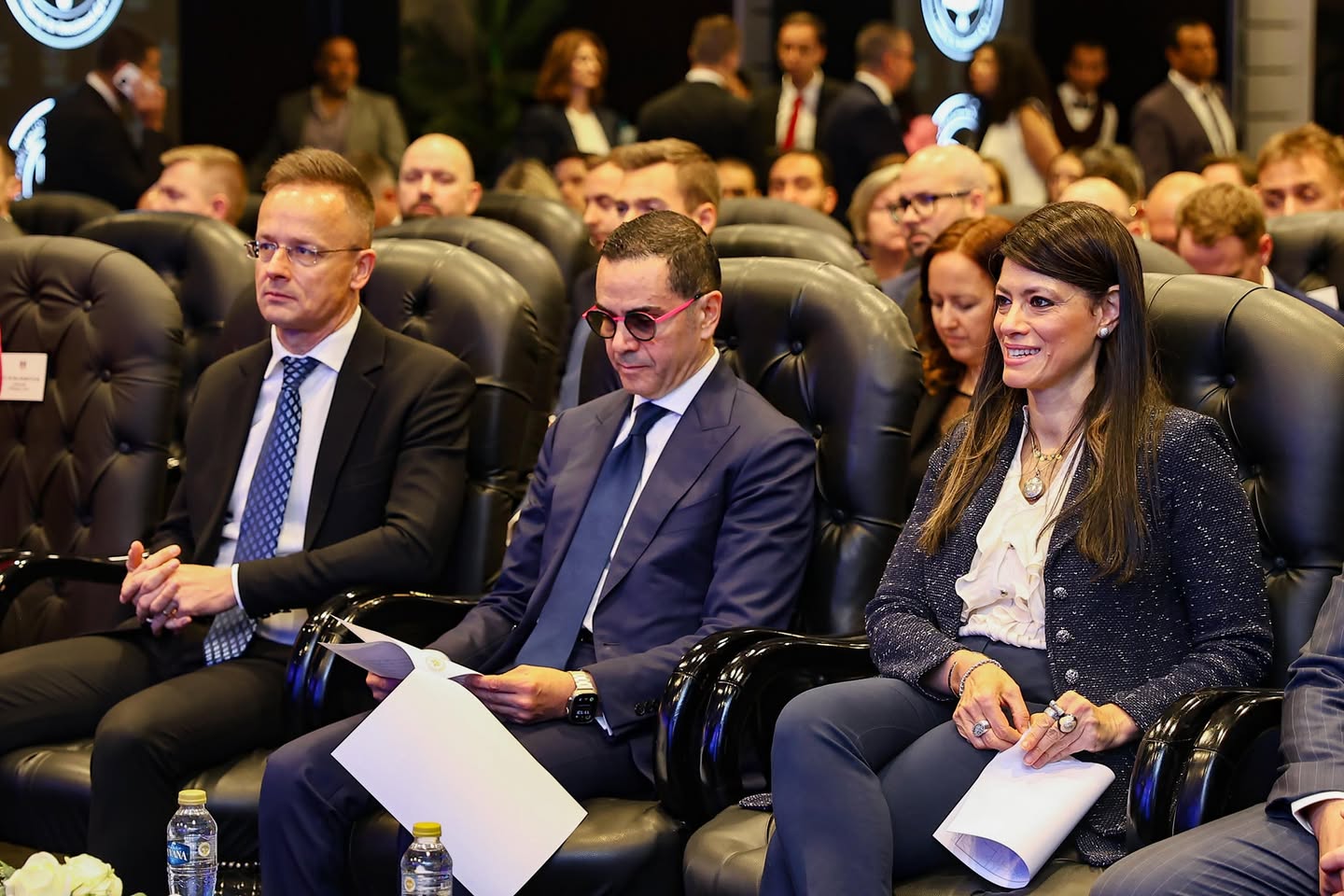
Al-Mashat stressed the depth of the partnership between Egypt and Hungary and the mutual commitment to moving forward towards broader horizons of fruitful and constructive cooperation in various fields, particularly in the economic, trade, and investment sectors, which have witnessed growing development in recent years. She added that relations between Egypt and Hungary are not new, but rather are rooted in decades of understanding and cooperation.
She added that the forum comes at a critical time, as the world
faces unprecedented economic and geopolitical challenges, requiring countries
to work together and adopt new models of cooperation based on innovation,
integration, and sustainability. She added that the business forum represents a
vital platform for exchanging ideas and expertise, exploring joint investment
opportunities, and enhancing direct communication between representatives of
the public and private sectors in both countries.
She clarified that trade relations between Egypt and Hungary have
witnessed remarkable development in recent years, adding that in 2023, the
volume of trade exchange between the two countries reached approximately $380.4
million, of which $87.1 million was Egyptian exports to Hungary, and $293.3
million was imports. She explained that this progress reflects the mutual trust
between the business communities of the two countries and reflects the quality
of the exchanged products and services and their suitability for the markets.
Dr. Al-Mashat also emphasized the importance of the Suez Canal Economic Zone,
which represents a fundamental pillar of Egypt's development strategy and an
attractive hub for international investment. She noted that this unique zone,
with its four industrial zones and six seaports, is a strategic gateway to
African and Middle Eastern markets and offers promising opportunities in
sectors such as logistics, automotive, solar energy, petrochemicals,
pharmaceuticals, and green hydrogen.
She noted that Egypt places great importance on industrial and
technological transformation and is working to strengthen partnerships with
friendly countries in this field, most notably Hungary. She noted the state's
commitment to developing key sectors such as pharmaceuticals, textiles,
building materials, and medical devices, with a focus on circular economy
models, environmental innovation, and smart manufacturing, which represent a
key driver of future economic growth. She also noted the importance of
localizing industry and leveraging Hungarian expertise in these fields.
Al-Mashat indicated that additional financing opportunities are available to Hungarian companies, most notably the European Union Guarantee Mechanism, valued at €1.8 billion, which is being implemented to support the expansion of Hungarian and other companies in Egypt.